Rules
How to play Grudge Isle
Build on an island, trade for what you lack, and be first to 10 victory points. Learning the rules takes about five minutes. The rivals you trade with take longer to figure out.
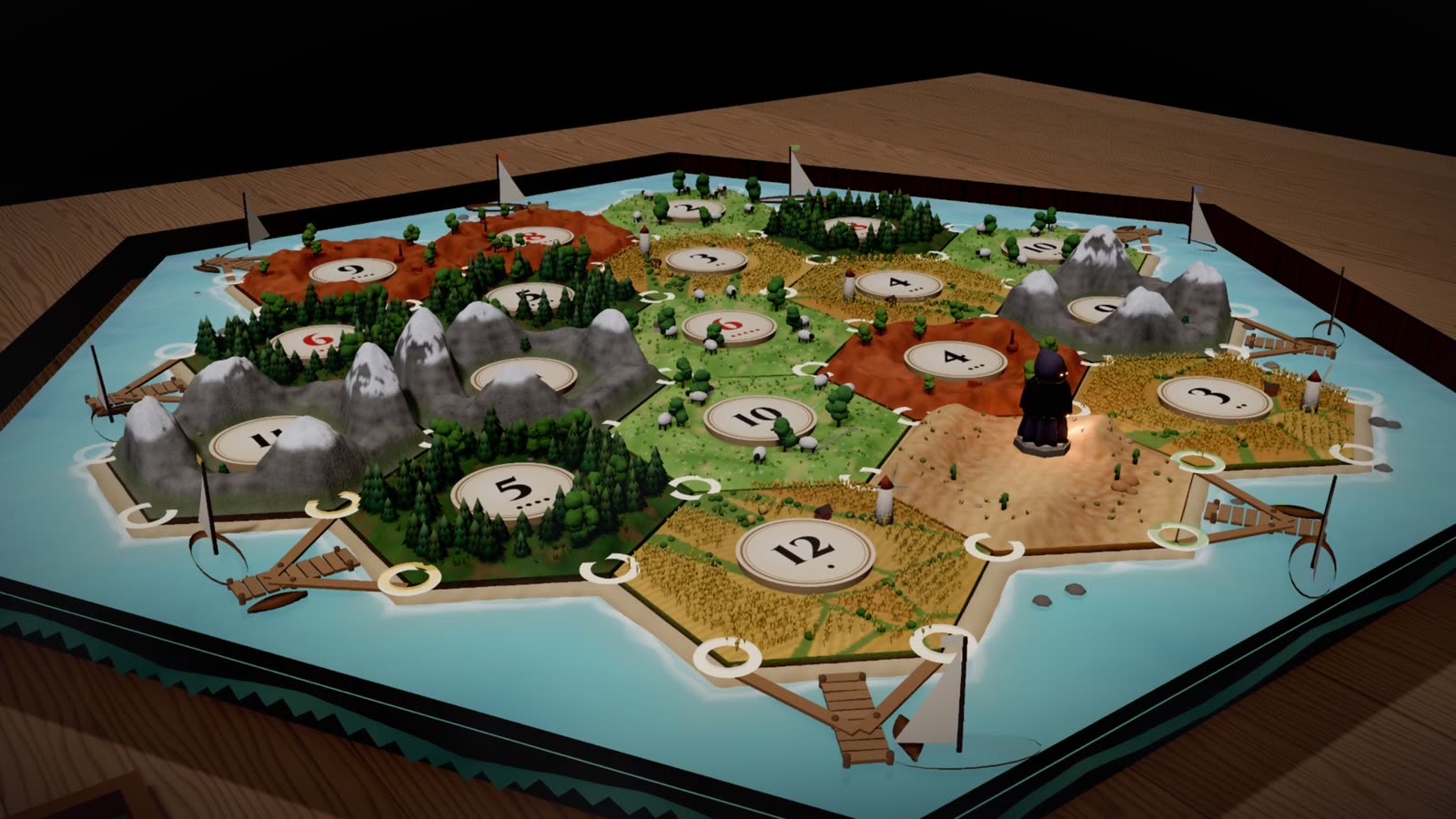
The goal
Everyone starts with two settlements on a randomly built island of hex tiles. Each tile makes a resource: forest gives wood, hills give brick, pasture gives sheep, fields give wheat and mountains give ore. The desert gives nothing. You spend resources to build roads, settlements and cities, and the first player to reach 10 victory points on their own turn wins.
Setup
- Everyone rolls. The highest roll places first.
- In turn order, each player places one settlement on a corner of the island and one road touching it.
- Then in reverse order, each player places a second settlement and road. The last player to place first gets to place second straight away, which evens things out.
- Your second settlement pays you one card of each resource around it, so you start with something in hand.
A turn
- Roll two dice. Every tile with that number produces. Each settlement touching it gets 1 card and each city gets 2. This happens on everyone's roll, not just yours, so you collect cards on other people's turns too.
- Trade. Offer a deal to the whole table or to one rival, or trade with the bank at 4 for 1 (3 for 1 or 2 for 1 if you own a harbor).
- Build whatever you can afford, and play up to one development card.
- End your turn.
What things cost
| Build | Costs | What it does |
|---|---|---|
| Road | 1 wood, 1 brick | Extends your network. Must touch your own road, settlement or city. |
| Settlement | 1 wood, 1 brick, 1 sheep, 1 wheat | 1 victory point. Collects 1 card when a neighbouring tile's number is rolled. |
| City | 2 wheat, 3 ore | Upgrades a settlement. 2 victory points and double production. |
| Development card | 1 sheep, 1 wheat, 1 ore | A random card: knight, road building, year of plenty, monopoly or a hidden victory point. |
Two buildings can never sit on neighbouring corners: there must be at least two edges between any two settlements or cities. Each player has 15 roads, 5 settlements and 4 cities.
Rolling a 7: the robber
Seven is the most common roll, and it produces nothing. Instead:
- Anyone holding more than 7 cards discards half of them, rounded down.
- The player who rolled moves the robber to any tile. That tile stops producing until the robber moves again.
- They then steal one random card from a player with a building on that tile.
In Grudge Isle, where the robber goes is personal. Rivals remember who robbed them. See the robber guide.
Development cards
- Knight (14 in the deck): move the robber and steal, like rolling a 7 but nobody discards. You can play it before you roll.
- Road Building (2): place two free roads.
- Year of Plenty (2): take any two resources from the bank.
- Monopoly (2): name a resource and everyone hands you all of theirs. Nobody will thank you.
- Victory Point (5): worth one point, kept hidden until you win.
You can't play a development card on the turn you bought it.
Bonus points
- Longest Road (2 points): the first player with an unbroken road of 5 or more pieces. Anyone who builds a longer one takes it. An opponent's settlement in the middle of your road breaks it.
- Largest Army (2 points): the first player to play 3 knights. Anyone who plays more takes it.
Trading
After rolling you can trade with anyone, on any terms you both agree to. When a rival makes you an offer you can accept it, refuse it, say Too steep so they sweeten it, or Counter with your own terms. You can also sweeten your own offer with a promise to keep the robber off them for two rounds.
This is where Grudge Isle differs from the board game in your cupboard: your rivals are AI players who remember how you've treated them. Refuse their deals, rob them or cut off their roads, and their prices go up. More in how grudges work.
Turn timer and controls
A table can be set up with a turn timer of 60, 90, 120 or 180 seconds. When it runs out, your turn is played out for you. On a computer, drag to turn the camera and scroll to zoom. Shortcuts: R roll, 1 road, 2 settlement, 3 city, D development card, T trade, E end turn, ? rules. On a phone everything is a tap away.
Questions people ask
How many victory points do you need to win?
Ten in the classic game, and you have to reach them on your own turn. Knights & Barbarians games go to 13.
What happens when you roll a 7?
Nothing is produced. Anyone with more than 7 cards discards half, and the roller moves the robber and steals a card from someone on that tile.
Can I trade when it isn’t my turn?
You can answer offers anyone makes on their turn, but you can only start a trade on your own turn, after rolling.
How long is a game?
It depends on the table. AI rivals take their turns quickly, so solo games move fast. With friends, set a turn timer to keep things going.
The table is set. Five rivals, and every one of them keeps score.
Take a seat